Sherwin Williams
A Multi-Brand Digital Transformation at Sherwin-Williams
Executive Summary
Brand
Sherwin Williams
role
Associate Creative Director, Product design
The Project
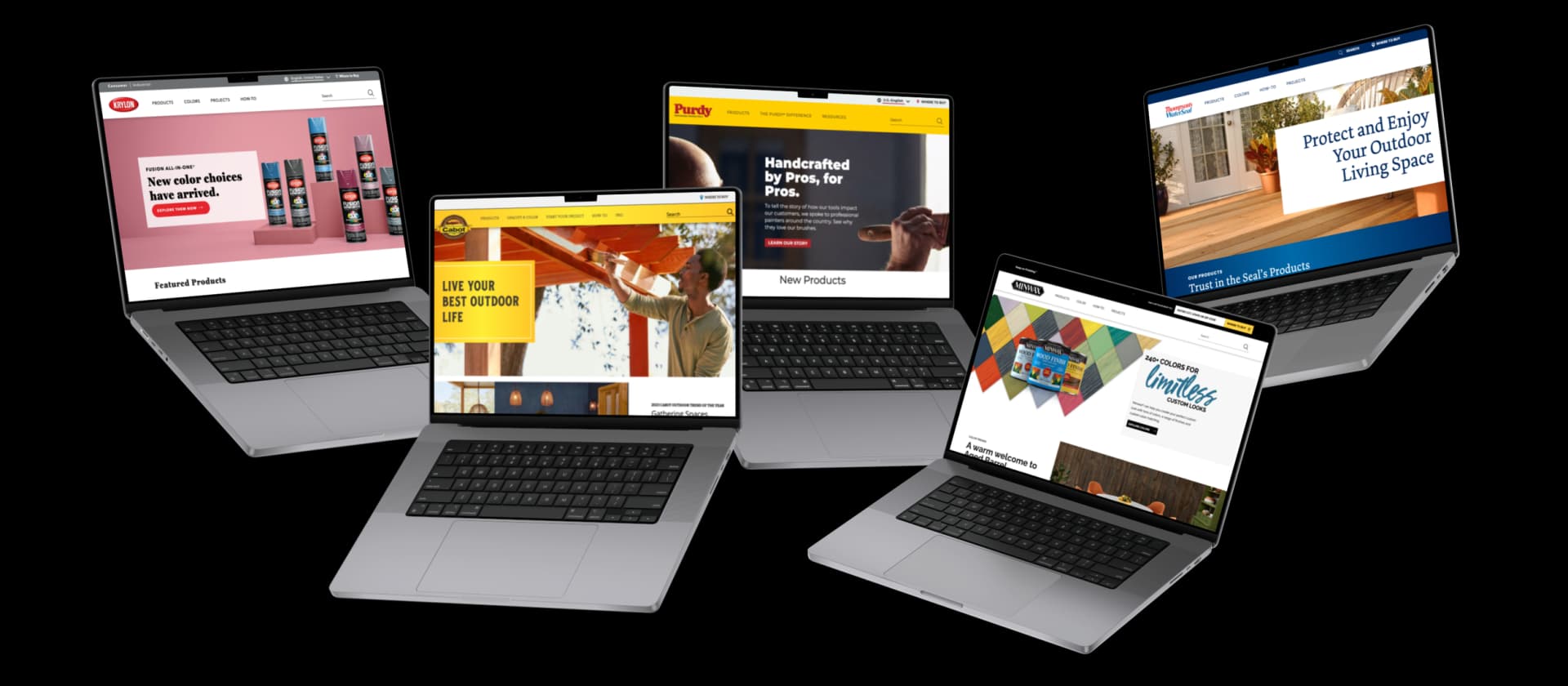
At Sherwin-Williams, I was tasked with leading the simultaneous relaunch of websites for five established consumer brands: Krylon, Cabot, Purdy, Thompson's Water Seal, and Minwax. Each brand carried decades of equity and a loyal customer base with distinct expectations.
As Associate Creative Director, I owned creative vision and product design strategy across all five properties—aligning cross-functional teams, establishing design direction, and ensuring each brand received a modern digital experience without losing the identity that made it resonate with customers. This wasn't a reskin; it was a strategic repositioning of how Sherwin-Williams' consumer brands showed up digitally.
My Role and Vision
Leading this initiative required balancing a unified approach with respect for each brand's distinct market position. Krylon speaks to DIY spray painters and crafters. Cabot serves woodcare enthusiasts and professionals. Purdy is the premium brush brand trusted by painters. Thompson's Water Seal owns the waterproofing space. Minwax is synonymous with wood finishing.
These aren't interchangeable audiences, and the brands couldn't feel interchangeable either.
My vision was to establish a cohesive digital foundation—shared UX patterns, consistent quality standards, unified technical infrastructure—while giving each brand flexibility to express its unique personality. The goal wasn't homogeneity; it was efficiency and excellence at scale.
Strategic Challenges
Brand Cohesion vs. Identity: Five brands meant five sets of stakeholders, each protective of their brand's positioning. We needed a system flexible enough to accommodate wildly different visual identities (Krylon's bold energy vs. Cabot's craftsman aesthetic) while maintaining UX consistency that reduced development overhead.
User Experience Optimization: Each brand served different user segments with different needs. A professional painter shopping Purdy brushes has different expectations than a first-time homeowner waterproofing their deck with Thompson's. Our designs had to reflect those differences without fragmenting into five siloed efforts.
Technical Scalability: Sherwin-Williams needed infrastructure that could support five brands today and more tomorrow. We couldn't build five bespoke solutions—we needed a system that reduced long-term maintenance burden while accommodating varied content needs and product catalogs.
Competing Priorities: Unlike a single-brand engagement where stakeholder alignment is challenging but manageable, this project required navigating five brand teams with legitimately different—sometimes conflicting—priorities. A feature critical for Purdy's professional audience might be irrelevant for Minwax. Sequencing, resource allocation, and compromise were constant negotiations.
Research-Driven Strategy
Before any design work began, we conducted market research, user interviews, and heuristic evaluations across all five brands. The findings painted a consistent picture with brand-specific nuances:
Product discovery was broken across the board. Users struggled to find the right product for their specific project—filtering was inconsistent, product pages lacked application guidance, and cross-selling opportunities were missed. For Cabot and Minwax especially, where product selection depends heavily on wood type and desired finish, this was a critical failure.
Rich how-to content existed but sat disconnected from the purchase journey. Thompson's Water Seal had excellent application guides that users never found. Krylon's project inspiration was buried three clicks deep. The content existed; the architecture failed it.
Mobile experiences lagged significantly. A surprising portion of traffic came from users researching products in-store on their phones—checking specs, comparing options, reading application instructions. The existing mobile experiences were frustrating precisely when users needed them most.
Finally, brand differentiation was unclear online. While these brands were distinct in customers' minds at the shelf, the websites failed to communicate those differences. The digital presence flattened brand personality rather than amplifying it.
Design System Approach
The heart of this initiative was a flexible design system that could serve all five brands without forcing them into a generic mold.
We standardized interaction patterns, navigation structures, and product detail page templates. These components could be built once and deployed across brands, dramatically reducing development time and ensuring consistent quality. Accessibility standards, performance benchmarks, and responsive behaviors were baked into the system—non-negotiables that every brand inherited.
What we customized: typography, color, imagery, tone of voice, and feature prioritization. Purdy's professional audience needed bulk ordering and contractor resources. Krylon needed project inspiration front and center. Thompson's needed seasonal messaging and regional considerations. The system accommodated all of it.
When a user landed on Minwax, they knew immediately they weren't on Krylon, even though the underlying system shared DNA. That was the goal—distinct experiences built on shared infrastructure.
Collaborative Execution
With five brand teams, marketing leads, developers, and executives involved, process discipline was essential. I established weekly design reviews to maintain quality and consistency, bi-weekly stakeholder syncs to surface concerns early, and sprint-based delivery that showed progress incrementally.
The real challenge wasn't logistics—it was managing competing interests without gridlock. Brand managers naturally advocated for their brand's priorities. Developers pushed back on scope. Marketing wanted features that would support upcoming campaigns.
My approach was transparency about tradeoffs. Rather than positioning decisions as mandates, I framed them as choices with consequences. "We can prioritize this feature for Purdy, but it means Cabot's timeline shifts by two weeks. Here's why I recommend this sequencing, but I want your input." This kept stakeholders engaged as partners rather than adversaries and maintained momentum even when priorities conflicted.
Outcomes and Impact
Improved Product Discovery Restructured navigation and enhanced filtering dramatically improved users' ability to find products. For Minwax and Cabot specifically, we introduced guided selection tools that walked users through project type, wood species, and desired finish to recommend appropriate products—a direct response to research findings.
Content Integration How-to content and project inspiration were woven into the purchase journey. Thompson's application guides now surfaced contextually on product pages. Krylon's project gallery became a primary navigation element rather than a buried afterthought. Time on site increased, and content engagement metrics improved across all brands.
Mobile Performance Mobile usability scores improved significantly. The in-store use case—users checking product details on their phones while standing in the aisle—was specifically optimized with quick-loading pages, prominent specs, and tap-friendly interactions.
Operational Efficiency The shared system reduced redundant development and established patterns extensible to future brand acquisitions. When Sherwin-Williams evaluates new brands, there's now a framework ready to absorb them rather than starting from zero.
Reflection
What made this project distinct from single-brand work was the constant negotiation between system-level thinking and brand-level advocacy. Both are legitimate perspectives, and neither can win completely. The system needs consistency to deliver efficiency gains; the brands need flexibility to serve their audiences authentically.
Finding that balance required something beyond design skills—it required facilitation, diplomacy, and a willingness to make imperfect decisions in service of forward progress. Not every stakeholder got everything they wanted. But everyone understood the rationale, and the final products reflected genuine collaboration rather than compromise by exhaustion.
The other lasting lesson: infrastructure is a leadership decision. It would have been faster in the short term to build five independent sites. The system approach required more upfront investment and more coordination overhead. But it positioned Sherwin-Williams for sustainable growth rather than accumulating technical debt with every new brand or feature request. That long-term view is where design leadership earns its value.